

Vandse Aithal and Paula Davies
Hywel Dda University Health Board and Popham Kidney Support
Background
Acute kidney injury (AKI) is a term covering a spectrum of injury to the kidneys, which can result from a number of causes. AKI is common, expensive to manage, prolongs hospitalisation and is associated with increased mortality.
A 2016 study by Sawhney in ‘KDIGO- reported high morbidity and mortality for AKI patients, with 30-day mortality at 24.2%, with severe cases at 36.1%, and a third developing Chronic Kidney Disease (CKD) within 90 days.
The incidence of AKI is estimated at 150 episodes per 10,000 population per annum. The total population of the Health Board (HB) is estimated at 385,600 and is predicted to rise to 425,000 by 2033. This would equate to 5,775 episodes of AKI per year.
Aims and Objectives
To optimise the treatment of patients with AKI in GGH with a dedicated AKI team.
As a Wales first, the implementation of an AKI Specialist Nurse would provide an education – focused, outreach clinical approach to ensure avoidable harm related to AKI is prevented. The service would streamline the management of AKI, reducing the incidence and prevalence of AKI, progression of severity of AKI and the need for acute HD as a single organ failure management in ICU in GGH.
This conforms with the NICE Acute Kidney Injury guidelines (NG 148), and quality standards (QS76).
Approach
The service was implemented through a multidisciplinary team approach. Four fundamental elements being identified:
- Robust patient referral system.
- Favorable education Programme.
- Timely Central Venous Catheter (CVC) insertion and initiation of acute dialysis preventing single organ CVVHF failure in ICU.
- Dedicated Follow up clinic for patients on discharge following an AKI.

Outcomes
A mixed method approach was used to evaluate the impact of the four key components of the service. Data was then thematically analysed to draw accurate conclusions.
Although still in its infancy the AKI service over the course of 14 months demonstrated clear evidence of the impact early recognition and treatment of AKI has in patients thus reducing the risk of complications.
Impact
30-day mortality is a significant indicator of risk in patients with AKI because it is consistently higher than in those without AKI, with the risk increasing with the severity of AKI.
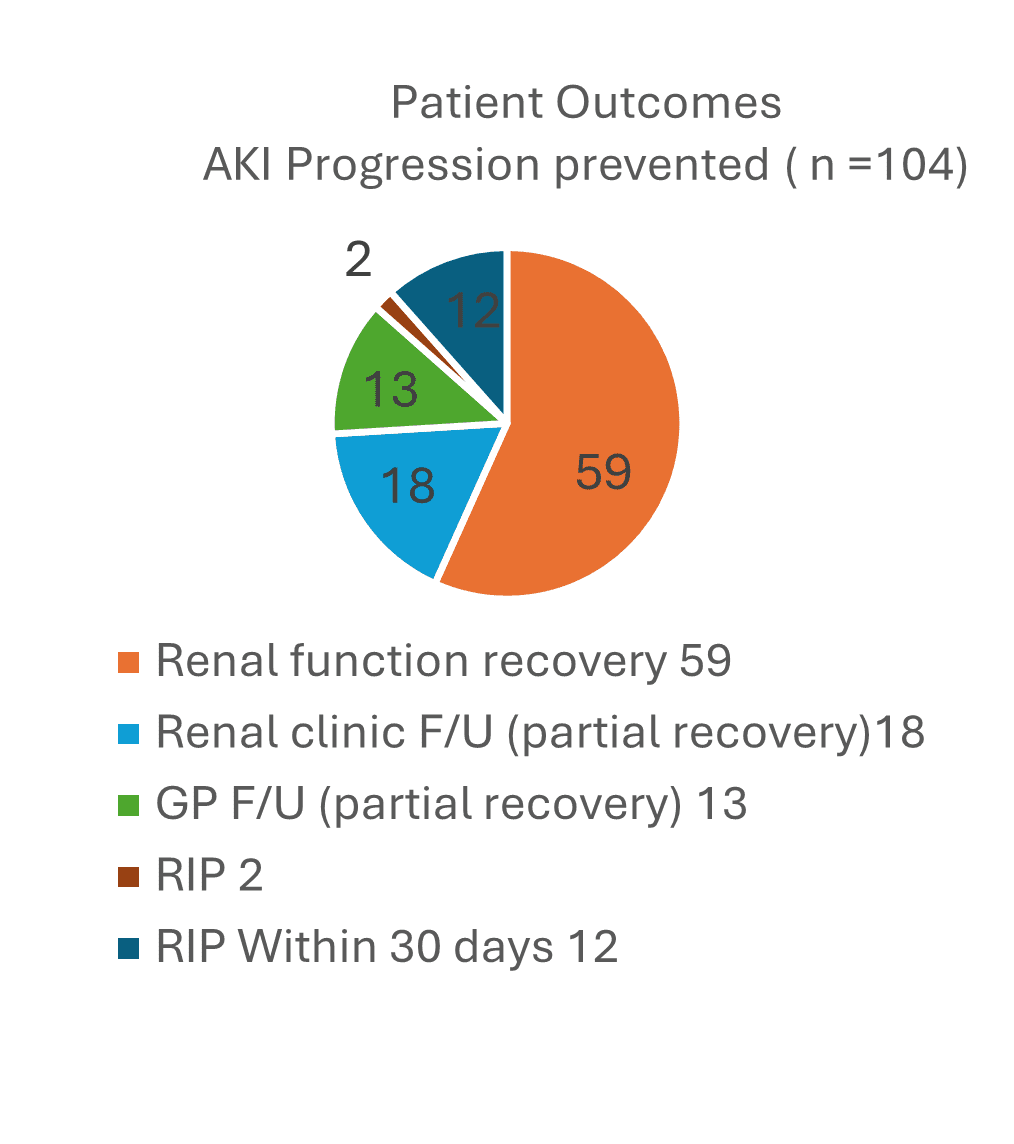
This data clearly supports the evidence for preventing AKI progression with more patients in the non-progressive AKI group showing full recovery (57% vs 11%) with associated less mortality (13.5% vs 39%).
Education sessions by the AKI Specialist Nurse proved a success, reflecting in 60% adherence to the AKI core principles thus influencing AKI management.
During the 10-month period when acute patients were not accepted for haemodialysis (HD) in the Renal Dialysis Unit (RDU) in GGH, 11 (39%) patients were transferred to the tertiary renal unit in SBUHB. 3 (27%) of these patients were suitable for Intermittent HD treatment in the RDU in GGH.
AKI Specialist Nurse follow up clinics had a positive impact on patient’s health and wellbeing. Dedicated follow-up sessions at GGH, provided care closer to home. 90% of the patients completing the survey reported better patient experience.
Since initiating the AKI service, compliance with NICE Acute Kidney Injury guidelines (NG148), quality standards (QS76) have increased from 0% to 78%.

“Doctor and AKI nurse were amazing, they were thorough, respectful and understanding. Felt I was listened too. They deserve a medal for the work they do.”
Service User
“AKI nurse was excellent. Efficient, understanding and informative.”
Service User
Conclusions
This unique Wales first AKI Service provides a platform to structure a service-wide programme, ensuring the basics of AKI management are implemented as standard, focussing on prompt recognition and early intervention for those at highest risk of poor outcomes.
Exemplifying multi-disciplinary and collaborative team working. It addressed deficiencies highlighted in AKI care, follow-up and provided a more streamlined communication between Renal and hospital teams.