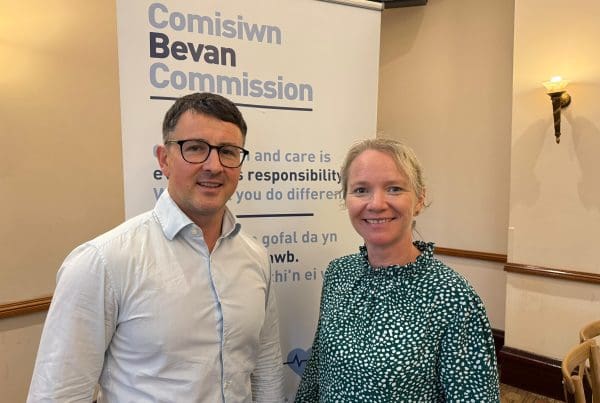


Ian Pope Susan Ikin and Caroline Tudor-James
The Rainbow Foundation (Delivering in Betsi Cadwaladr University Health Board)
Background
Most people over 65 with musculoskeletal (MSK) conditions are managed in primary care, with 25% of a GP caseload MSK in origin. In Wrexham, one in five people are over 65, many living with complex health and mobility issues. Sarcopenia (age-related loss of muscle mass and strength) contributes to reduced mobility and increased risk of falls and frailty. Falls and frailty are key factors in a sudden decline in health. Fragility fractures cost the NHS £1.1 billion in hospital stays every year.
Aims & Objectives
- Reduce risk factors associated with surgery and the need for surgery.
- Increase knowledge and self-management of long-term conditions.
- Effectively reverse and reduce frailty.
- Reduce pain.
- Help improve MSK conditions, and reduce falls.
- Reduce risk of Dementia (through regular exercise).
Methodology
Active Futures builds strength and confidence, and tackles falls, frailty and mental health; it also addresses wider determinants of ill health and uses peer support to drive positive behaviour change and encourage attendance.
Active Futures supports older people with MSK conditions, living with frailty, or at risk of falls through a three-step approach Participants (56% with a history of falls in the last 12 months) attend a twice-weekly, physiotherapist-led circuit classes held in accessible community venues with transport provided. Each 12-week programme began with a functional fitness MOT and mental health assessment to set baselines. Outreach support is offered to address wider determinants of ill health which may impact on engagement with the programme. Each session is followed by an opportunity to connect socially, building peer support and promoting sustained attendance, positive behaviour changes and healthy habits. This COM-B framework was used to understand and influence behaviour change.
Funding Model
The funding model is a cross-subsidy funding approach. “Fit Futures” subsidises “Active Futures” ensuring inclusivity and sustainability.

Outcomes & Impact
Julia’s Story
Julia began the Active Futures classes to maintain independence and rely less on her family. She had a hip operation and was listed for the other hip too. She is in her early 70s.
Her left arm has been 70% contracted since a severe burn in her childhood years. She says:
“One is shorter than the other and I was in pain. I used to use a heat pad, but I no longer use that, and I have far more flexibility. After 40 years, the left arm is now the same length as the right”
Results from Active Futures showed Julia has improved:
- Increased flexibility in Sit and Reach test by 9cm and by 13 cm in Back Scratch test.
- Able to complete 24 chair stands in 30 seconds at follow up compared to 9 at baseline.
- Increased her 6-minute timed walk by 60% to 200m and no more walking sticks!
She reports that she has lost 1.5 stone in weight since starting and is motivated to eat better and do a lot more. She now cuts her own toenails and no longer uses a shoehorn to get shoes on.
Clinical Outcomes
Following the Active Support programme:
- 90% of people are more physically active
- 79% increase in wellbeing scores
- 72% decrease in frailty scores
- 70% felt more connected to people
- 80% continue their progress in Fit Futures
- 96% increased 6-minute walk distance
- 93% increased chair to stand count
- 95% improved up and go scores
- 81% improved flexibility scores

System Impact
Long term health benefits result in:
- Fewer GP and hospital visits.
- Decrease in ambulance call outs.
- Reduced A & E attendance due to falls. At pre-assessment, 30% had experienced an A & E admission due to falls. There were no admissions two years on.
System Saving: £2,754 of social value created for every person.
Social Return on Investment
For every £1 spent, £14.02 in social value is generated, based on improvement in patients’ physical health and overall wellbeing.