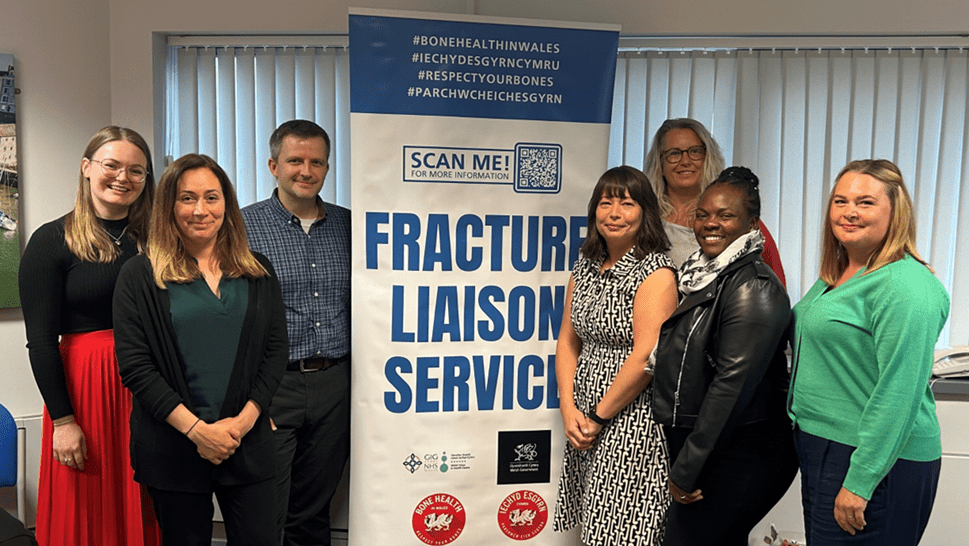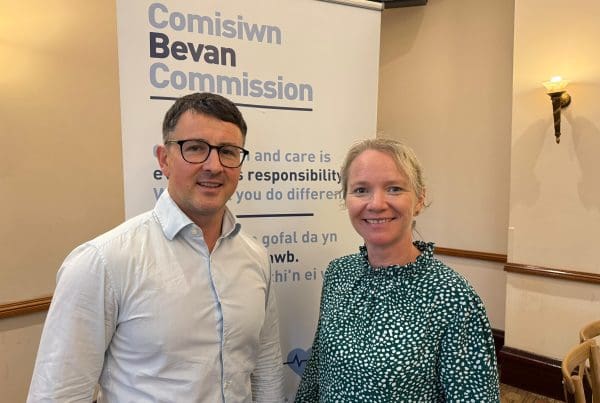


Will Backen and Tracy George
Hywel Dda University Health Board
Background
Our Fracture Liaison Service (FLS) is a new service which commenced in September 2024, based across all four acute sites in our Health Board. To provide high quality, timely and seamless care for patients we need to work flexibly across the different sites as one team including providing internal cross cover. We work virtually and thus require an approach to allow us to coordinate workloads across the whole team on different sites. This would allow us to work efficiently enabling patients to receive timely assessments and interventions which they require.
This is particularly important for the FLS due to the number of patients we estimate that we will see annually (approximately 3800 patients a year).
Aims and Objectives
Our aim was to create a FLS dashboard within SharePoint, encompassing the functions that the team require to deliver safe standards of care across the whole Health Board.
Our objective was to utilise applications already available to us to minimise costs, such as MS List, MS Teams and skills from our internal software developers.
Approach
To achieve our aims and objectives we collaborated with our digital and software development leads, meeting every fortnight to produce the programme required. This was then presented to our Information Governance team for approval. We then evaluated this tool through questionnaires to measure functionality, usability and usefulness. These were distributed to the internal team, the management team and a wider group.
Outcomes
PADDINGTON was developed:
Patient And Diagnostic Dashboard Incorporating Notification Generation & Tracking Of Network
The key benefits:
- It allows admin staff to highlight upcoming activity such as organising blood tests or appointments.
- Facilitates the safe distribution of caseloads across all sites, ensuring no inequality. It is innovative as it allows for more equitable distribution in areas with higher demand or where there is sickness or leave.

- It also includes: Electronic referrals, digital assessment proformas which feeds into Power BI, holds key documents which allows transition into PDF, and holds useful tools such as Promptly, FRAX, Calcium calculators and more.
- Team feedback – This included 4 practitioners and 3 admin.
- The team demonstrated usability and envisage using it several times a day
- 81% of the team thought it would make collaborative working easier
- 63% would recommend it to other FLS teams
- 100% of the practitioners thought it would save them time managing their caseloads whilst increasing the quality of their work.
- Management team feedback – This included Clinical Lead, Service Delivery Manager and Service Support Manager.
- 100% of this cohort thought Paddington would make the patient experience of the service better.
Impact
The impact of introducing Paddington into the FLS at HDUHB means we can now:
- Demonstrate that the patients’ journey is at the heart of the pathway.
- Share workload with ease across a virtual platform throughout a rural area.
- Have live key performance indicators on display for the team to visualise.
- Undertake Quality Improvement projects simply and in real time with less resource.
- Early indicators suggest that Paddington will demonstrate a reduced variation in the FLS Pathway.

Conclusions
A digitally enabled, low-cost dashboard can support safe, efficient, multi-site FLS delivery in a rural health board. Using existing platforms can improve coordination, visibility of workload, and patient experience without additional system investment. The approach is transferable and offers a practical route to reducing variation and supporting scale across Wales.
The Project Team