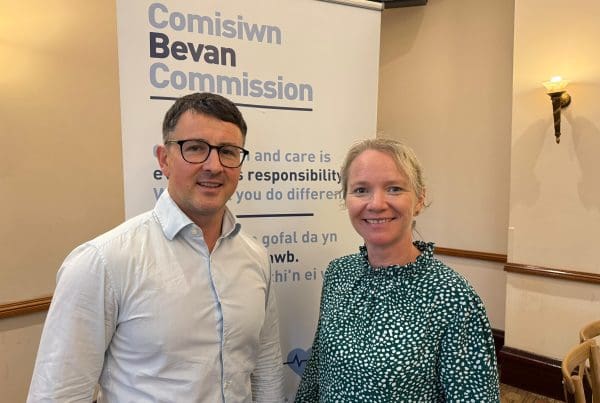


Lauren Davies and Aimee Bowen
Hywel Dda University Health Board
Background
Patients should be seen and treated on the Urgent Suspected Cancer Pathway within 62 days of referral. This was not happening in the gynaecology department in Hywel Dda for patients on a post-menopausal bleeding pathway.
Average hysteroscopy wait: 75 days.
Key causes of delay:
- Radiology staff shortages – limited access to ultrasound.
- Increased demand for ultrasound services.
- Delays in histology reporting.
- Limited access to pre-assessment (GA conversion).
Impact:
- Caused significant bottlenecks in the pathway.
- Variation across the three acute hospital sites.
- Inequity of access that created inconsistent patient experience.
- Extended waiting times for patients.
Aims and Objectives
- Reduction of stress and anxiety for patients.
- Improve access to diagnostic investigations.
- Reduce overall waiting times within the Urgent Suspected Cancer pathway.
- Provide patients with same-day outpatient consultant, ultrasound scan and biopsy/hysteroscopy (where indicated).
Approach
- Establishment of an Improvement Group.
- Standardisation and redesign of the pathway through the development of a One Stop Clinic model. This model brought together key diagnostic tests including OPA, ultrasound, biopsy, and hysteroscopy if needed on the same day.
- Pilot of new model in Bronglais General Hospital in May 2024. This demonstrated a reduction in waiting times and improved efficiency in the pathway.
- Model spread and scaled to Glangwili General Hospital and Withybush General Hospital in Summer 2025.
Outcomes
New pathway with a One Stop Clinic model implemented at three acute sites in Hywel Dda for patients on a post-menopausal bleeding pathway.
Impact
Since implementation, significant improvements have been observed:
- Average waiting times reduced from 178 days to 29 days (Fig. 1).
- A streamlined, patient-centred pathway providing timely access to diagnostics and treatment.
- Improved patient experience with reduced anxiety and faster reassurance.
- Increased efficiency of discharge, limiting unnecessary referrals to diagnostic hysteroscopy.
- Progression towards achieving the national standard of 62 day first definitive treatment target.
- Establishment of five One Stop Clinics, running weekly across the three acute sites.
- Release of approximately 40 ultrasound slots per week back to radiology services across the health board.
- Creation of 18 ring-fenced hysteroscopy appointments dedicated to One Stop Clinic patients.

Fig. 1: Days between point of suspicion and diagnostic: HDUHB Gyneacology
Conclusions
The introduction of the One Stop Clinic model has delivered a measurable and sustainable improvement to the post-menopausal bleeding pathway within HDUHB.
The model has:
- Significantly reduced waiting times.
- Standardised care provision across sites.
- Released diagnostic capacity within radiology.
- Enhanced the skills and flexibility of the workforce
- Improved patient experience through faster, more efficient pathways.
The One Stop model demonstrates a scalable and effective model which shows service transformation as well as supporting both patient outcomes and system resilience.