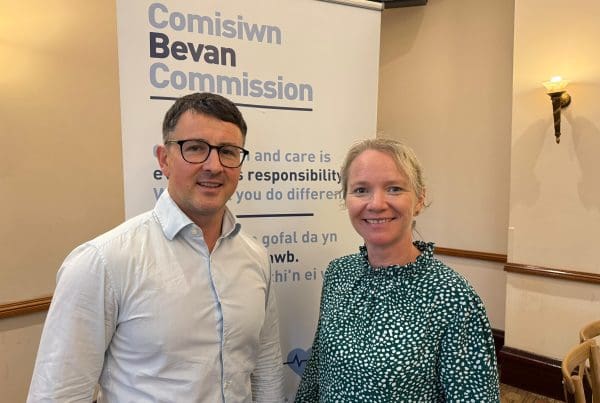


Kim Bevan (Tend VR), Janet Whiteman (New Horizons Mental Health) and Lisa Wills (Art Factory)
Tend VR, New Horizons Mental Health and Art Factory (Delivering in Cwm Taf Morgannwg University Health Board)
Background
There is a wealth of evidence for the efficacy and effectiveness of Mindfulness Based Cognitive Therapy (MBCT) as an effective treatment for depression and anxiety and for the potential of VR as a delivery tool.
Offering a mindfulness-based intervention (MBI) using the key elements of MBCT via immersive virtual reality (VR-MBI) provides a potential solution for people who normally struggle to access mental health services. This is something we wanted to explore in Wales.
We knew that if this pilot project demonstrated similar feasibility, acceptability and efficacy results as shown in our previous VR-MBI studies then we will have a truly scalable, accessible and affordable solution to tackling access issues that lead to long NHS Wales waitlists for mental health interventions, which can lead to poor outcomes for service users.
Aims and Objectives
Our overall aim was to explore the feasibility, acceptability, accessibility and impactful of the Tend VR-MBI programme when delivered at a place of the individual’s choosing, to people who struggle to access traditional mental health services. Our objective were:-
- To evaluate the feasibility, acceptability, accessibility and levels of engagement with Tend VR-MBI and explore its feasibility as a potential solution to waiting list and accessibility in mental health services in Wales
- To evaluate signs of the clinical efficacy of the VR-MBI programme.
- To evaluate the engagement, sustainability, experiences and retention levels of participants.
Approach
- All participants completed an online Expression of Interest (EOI) screening form.
- Eligible participants who wished to participate after an introduction to VR were asked where they wanted the programme – all chose either New Horizons or Arts Factory (not home) and completed consent forms.
- We used a mixed methods approach combining quantitative outcome scales (PHQ-9, GAD-7 & WSAS) to measure impact (baseline and end of study) with qualitative interviews at the end of the programme to review participants’ engagement and overall experience with the VR-MBI programme.
Outcomes
We developed a new version of an existing mental health product, VR-MBI, adjusted to make it deliverable in a local venue as well as at home. The results from our project suggests that Tend VR-MBI is a feasible and acceptable approach to improving the mental health of people with mild learning difficulties and those for whom accessing traditional mental health services has proven challenging. We found that, for participants with learning difficulties, a small amount of additional support was required but their outcomes and feedback was very positive. This project has enabled us to develop a feasible, acceptable, comprehensive approach to supporting the mental health of underserved individuals in Welsh communities.
Impact
Although the size for the pilot was relatively small (n=12), the interventions demonstrated statistically significant improvements in mental health (table 1), with self-reported improvements in depression and anxiety symptoms and in functioning.

Table 1: Pre and post intervention outcomes measures (mean)
Participant Experience
Overall experience: Mean score 4.73 / 5
Likelihood to recommend: Mean score 4.64 / 5
Participants reported consistently positive experiences with the programme and indicated that they would be highly likely to recommend Tend VR-MBI to friends and family.
“It really helps reduce my anxiety and helps me relax. The narrator’s voice is very soothing.”
Participant
Conclusions
“Looking at the future now, I’ve got life-changing skills that I can’t lose in terms of just managing, you know, everything that goes on in my head and stuff and, you know, learning that I’m going under a lot of stress and that’s okay. But I’ve got the tools to deal with it now and I’m going to get through it.”
View the project poster and slides from the Cohort 9 Bevan Exemplar Showcase