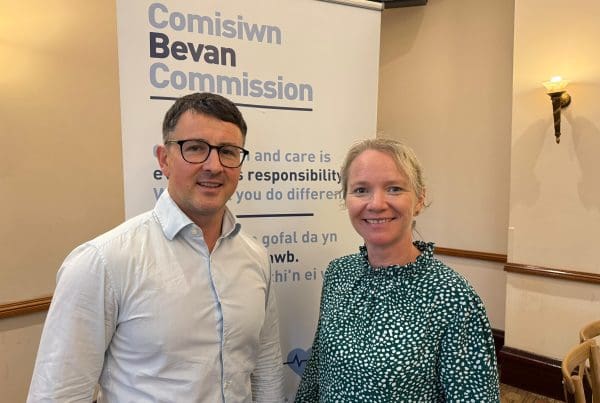


Sheelagh Rogers (CAVUHB) and Nagham Katif (Cardiff University)
Cardiff and Vale University Health Board and Cardiff University
Finalist – Acting as One Team Award, NHS Wales Sustainability Awards 2025
Background
Healthcare is a significant contributor to carbon emissions. NHS Dentistry accounts for approximately 3% of the NHS’s total carbon footprint. Despite growing interest in sustainability across both Dental School and Dental Hospital, collaborative leadership and strategic direction was required. Recognising the urgency of the climate crisis, the need for systemic change, and alignment with national policies, both institutions appointed Sustainability Leads to collaborate on this urgent agenda.
Aims and Objectives
- Establish a Joint Sustainability Working Group.
- Support and promote projects aimed at reducing waste and driving sustainable change.
- Identify cost savings and reduction in carbon emissions associated with change.
- Embed sustainability across all levels of dental education.
- Raise awareness-build a culture of sustainable behaviour.
Approach
Using core sustainability principles in conjunction with the Bevan Commission’s WASTES typology, the Joint Sustainability Working Group mapped and planned projects in areas of waste and process inefficiencies. Students, NHS dental trainees, clinical and non-clinical staff undertook these projects.
Sustainability was introduced as a core educational theme in the new dental curriculum, enabling introduction at undergraduate level.
Raising awareness and engagement with planned projects- outcomes were disseminated through the inaugural Sustainability in Dentistry (SID) talks.

Outcomes
- Established a Joint Sustainability Roadmap.
- Completed 15 projects- improving service delivery, patient care, reduction of waste whilst meeting students’ and trainees’ educational requirements.
- Introduced Sustainability through undergraduate and staff activities.
- Raised awareness through completed projects, local activities and forums.
Impact
Evaluation of dental theatres focused on training dental nurses as scrub nurses. In one year, this change is expected to prevent 75 patient cancellations, saving 56 hours of theatre time and £43,290 in costs.
The Decontamination Team (DSDU) improved protocol by eliminating a layer of paper wrapping, resulting in annual cost savings of £1,670.50 and a reduction in carbon emissions of 1,761.17 kg CO2.
SID talks drew an audience of 30 attendees, with positive feedback: “Presentations were very relevant and informative.”
Conclusions
- Co-leadership and engagement with stakeholders are crucial for implementing this agenda in both clinical services and dental education.
- The Bevan Commission WASTES typology provides an excellent foundational framework for identifying areas of change.
- Not all projects yield the same cost savings or carbon emissions but contribute to integrating quality improvement practice into dental education.
- Sustainable healthcare is firmly on the map within the Dental Hospital.