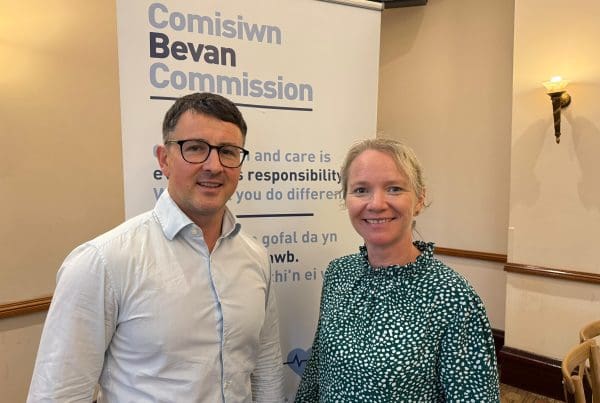


Caroline Tudor-James and Susan Ikin
The Rainbow Foundation (operating in Betsi Cadwaladr University Health Board)
Background
System Pressure on Acute Services: Nationally falls in people over 65 lead to over 220,000 emergency admissions and four million bed days each year. In Wrexham, older adults account for 8,053 A&E attendances and 8,456 bed days (2024).
Impact of Falls and Long Lie: Frail older people often face long waits for an ambulance after a fall. This increases risks such as dehydration, hypothermia and pressure damage. A “long lie” of over an hour is associated with 50% mortality within six months.
End-of-Life Care Gaps: Many people in their last year of life are admitted to hospital, contributing to bed pressures and over-medicalised care. Most prefer to die at home, yet over half die in hospital.
Population Trends and Future Demand: Wrexham’s over-85 population is expected to double by 2030 (to 6,000), with palliative care demand rising by 42% by 2040. Growing dementia prevalence means more people will experience severe dementia in the final months of life.
Aims & Objectives
- Decrease non-elected admissions to hospital.
- Decrease number of bed days in hospital and over-medicalisation during end stages of life.
- Promote a move from resistance to acceptance and dignity at end of life.
- Increase the number of people who die well in a place of their choice.
- Increase patients and carers understanding of end-of-life stages and choices at end-of-life.
- Reduce repeat hospital readmissions in the last 2 years of life.
Innovative Funding Model
In My Place was offered full investment through a Social Impact Bond, providing an Invest-to-Save model where costs are repaid only if agreed outcomes — such as reduced unplanned bed days — are fully achieved. Support from Social Finance included data analytics, operational expertise and dashboard development, creating a risk-free way to test the model while aligning incentives with measurable improvements.
Although the original 2022 offer was not progressed in time and funding was later redirected to another health board, strong clinical leadership and clear repayment mechanisms remain. Partners are now revisiting the opportunity to bring this proven model of care to Wrexham.
Integrated Model of Care:
‘In My Place’ addresses the lack of Future Care Planning (FCP) across Wrexham, and supports behaviour change. Making FCP a routine part of care, like birth planning, reduces stigma, helps professionals to honour end-of-life wishes, and builds on best practice.
In My Place Model: Tailoring healthcare to individual patient needs, preferences, and values. Noting FCP is essential to prevent repeated, unnecessary transfers to A&E during the last years of life.
Rainbow Response (Hospital Avoidance) Service: A proactive community team preventing unnecessary hospital admissions.
- Nurse prescriber-led team, 7 days/week, 7am to 10pm, with a 2-hour response time.
- Supports 2,347 call-outs/year.
- Integrated with the Wrexham-wide hospital avoidance scheme and Palliative Care Team.
- Responds to uninjured falls, deterioration, infections and end-of-life needs.
- For people over 65, living with frailty and/or dementia, at home or in residential care.
Future Care Planning (FCP) Service: Engages patients and communities in future care discussions to align treatment to long term goals.
- Referrals from Rainbow Response Team and the community.
- Five days/week, 9am to 5pm.
- Led by enhanced social prescribers linked to all GP practices.
- Supports individuals to make informed decisions about their end-of-life wishes.
- Provides training for carers and guidance on the natural stages of dying, helping more people to die well at home.
Impact Assumptions and Benefit Analysis
The target population is 1,261 end-of-life patients per year. The service is expected to support 50% annually, which would be approximately 631 patients per year. The median number of admissions in the last year of life is 2.3 non-elective admissions with an average length of stay of 16.7 days. This service aims to reduce admissions by 435 non-elective patients per year.
System Value over 3 years = £6.54m (System savings to the NHS), with £4.49m retained by the Health Board
Key Insights and Learning
Billy’s Story – a small step in the right direction
When Billy had a fall he experienced a long lie of 20 hours, before being admitted to hospital. The Red Bag (and Future Care Plan) ensured that Billy’s medical information and care preferences were immediately available. Billy experienced a smooth transition to his chosen place of care where his dying wishes were treated with dignity and respect.
Future Care Planning alone has shown:
– Improved patient agency.
– Reduced hospitalisation.
– Better carer confidence and system coordination.
Unfortunately Billy’s experience remains common for many frail older people who are admitted to hospital in Wrexham. Older people continue to experience the long lie, followed by prolonged hospital stays, unnecessary medical interventions and loss of independence