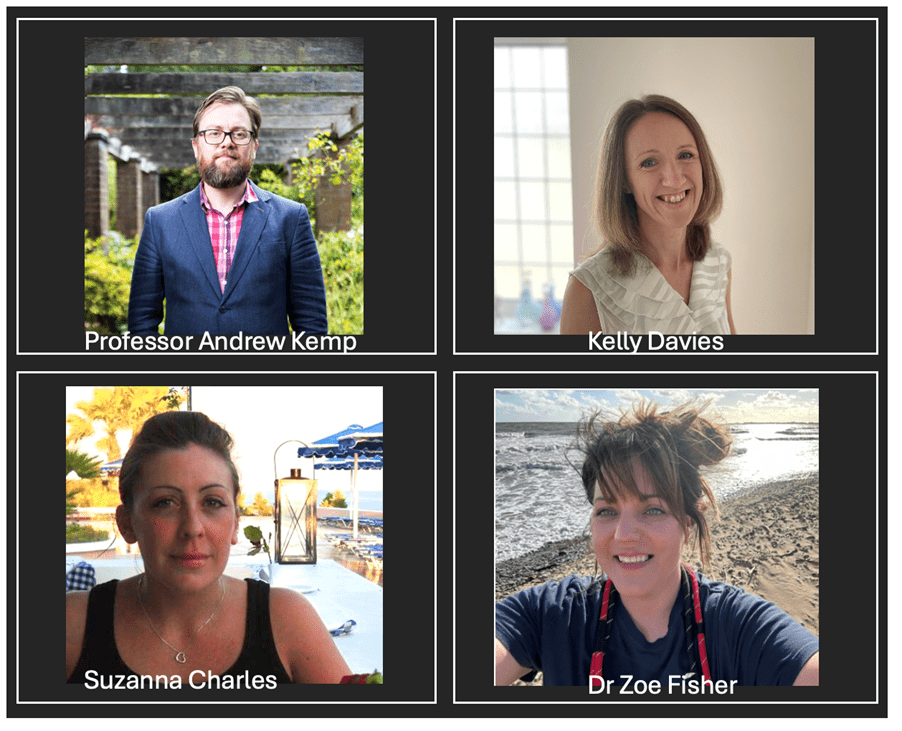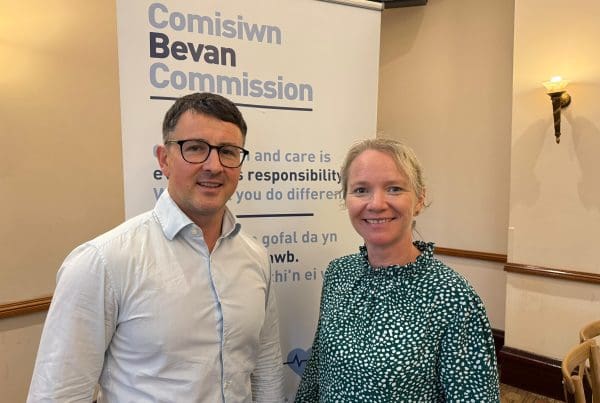


Zoe Fisher, Kelly Davies, Andrew Kemp (SBUHB and Swansea University) and
Suzanne Charles (SBUHB)
Swansea Bay University Health Board and Swansea University
Background
Chronic conditions and mental health needs now dominate the health landscape, yet services often remain reactive and focused on symptom management rather than prevention and resilience-building. This project brings wellbeing science into practice by creating and scaling evidence-based interventions across healthcare and higher education settings in Wales. The initiative targets two main groups, people living with acquired brain injury (ABI) and university students, demonstrating flexible application and systems-level learning.
Aim
To embed wellbeing science into practice by developing sustainable, co-produced interventions that empower people to live well with chronic conditions, improve student wellbeing, and support system-wide change towards resilience and prevention.
Objectives
- Promote holistic wellbeing in people living with acquired brain injury
- Promote holistic wellbeing in undergraduate students
- Scale wellbeing interventions
- Disseminate digital and written resources to enhance significance and reach
Approach
- Trained teams of clinicians to deliver wellbeing programmes using the GENIAL meta-framework.
- Adapted and delivered wellbeing modules within university curricula, combining lectures, workshops, and experiential practices.
- Piloted interventions with diverse groups (students from healthcare, science, biosciences, history; people with other chronic conditions).
- Co-produced written resources, a commissioned book, and digital tools (videos, app) for independent practice.
- Evaluation through surveys, focus groups, feedback, and validated scales (e.g., WEMWBS).
The Wellbeing Intervention

Outcomes
Acquired Brain Injury
- Ongoing delivery established across 3 additional Health Boards Participants reported skill, knowledge and motivation gains.
Students
- 256 psychology students experienced significant wellbeing improvements, now embedded into curriculum with plans for expansion.
Scaling
- Pilots proved adaptability to chronic conditions & integrating across academic disciplines engaging students across multiple disciplines and new clinical teams.
Resources
- Development of clinician/patient manuals for publication (with Routledge December 2025), co-produced digital media with people with lived experience and Snakes & Ladders wellbeing app.
Impact
“The group has been like the Japanese art form of kintsugi, this is where they patch up and repair broken pottery using gold. Instead of hiding the cracks they make it more beautiful, stronger and just as useful.”
“Embedding wellbeing as a routine part of study and care gives people tools for resilience in life transitions.”
“What stood out for me ..was really the mind body connection and how that makes a lot of sense particularly with the people with fibromyalgia but for all the conditions that we work.”
“Manuals and digital resources are invaluable for supporting ongoing recovery and self-management.”
Conclusions
- Evidence-based positive psychology intervention can be scaled to help more people with brain injury build wellbeing
- Wellbeing science improves student outcomes when embedded in curricula
- Adaptability across contexts is supported
- Resources strengthen sustainability and reach
- Co-production enhances effectiveness and authenticity
- System-wide wellbeing-improvements are achievable
View the project poster and slides from the Cohort 9 Bevan Exemplar Showcase