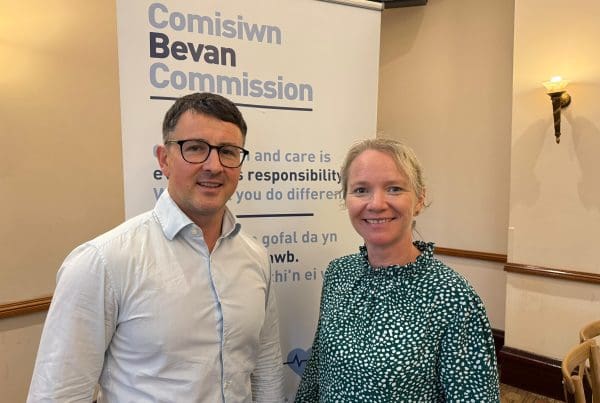


Brian Laing
Betsi Cadwaladr University Health Board
Background and Context
Wicked challenges require radical thinking. Our public services need to adapt and evolve to more relational & outcomes focussed models of planning and care delivery. And we need to do this alongside the communities we serve.
Despite various policy commitments, there is an evident lack of consistency and clarity regarding what constitutes effective community engagement and co-production, leading to fragmented approaches and limited scalability. This ambiguity often hampers the ability of stakeholders to evaluate impact and share learning across systems.
This research is intended to provide our communities voice & agency to take shared accountability for delivery and for evaluating shared outcomes.
Methodology
Following a double diamond methodology, stakeholders were engaged and participative in the process throughout in order to collectively define the challenge, and to develop solutions.
The research consists of:
- A comprehensive literature and evidence review to identify effective community engagement and co-production methods and to evidence the impacts these can have on health & wellbeing outcomes
- A series of stakeholder workshops to gather practical insights at the hyper-local level
The insights are used to develop a practical framework which could be applied at various system levels.
Key Insights

A Practical Framework for Application at Local, Regional and National levels
1. Structural Investment and Systems Integration
Firstly, a sustained structural investment is required to move beyond short-term, project based models. Embedding co-production and community participation within commissioning and regulatory frameworks, and allocating core funding to support community infrastructure and leadership development, are all considered essential steps towards embedding and institutionalising these practices.
2. Capacity Building and Workforce Development
Secondly, capacity building must be prioritised across both professional and community domains. The health and care workforce requires capacity and support for training in facultative, relational, and power sharing practices while communities, particularly those which have been historically marginsalised, must be supported to develop leadership, organisational capacity, and participatory confidence.
3. Embedding Equity and Inclusion
Equity must be embedded as a guiding principle across all stages of design, implementation, and evaluation. This includes prioritising engagement in high-need communities, adopting intersectional approaches to understand differential impacts and ensuring that power is re-balances and shared meaningfully with those most affected by health inequalities. This shift represents not only a strategic imperaitive but a moral one: to ensure that health systems are shaped with, not merely for, the populations they serve.
4. Creating a Lasting Legacy
Finally, these approaches must be adopted as a means to create a lasting legacy through evaluation., learning and accountability. In order to re-build and maintain trust, shared ownership and accountability, organisations should come together in partnership alongside empowered communities.